Tannery Wastewater Treatment Technology for Chrome, Sulfide and Organic Control
Product Details
Tannery Wastewater Treatment Technology for Chrome, Sulfide and Organic Control
Sulfide Wastewater Treatment
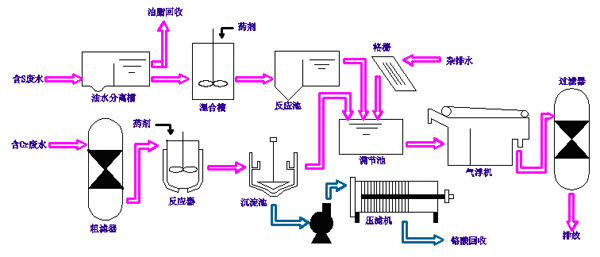
Sulfide-laden wastewater from tannery beamhouse operations is treated using catalytic oxidation. Manganese sulfate (MnSO₄) is added as a catalyst to accelerate the oxidation of sulfides. After catalytic oxidation, a sulfur removal aid is dosed to enhance precipitation. The pH is then adjusted to neutral. Following sedimentation, the removal efficiencies are as follows: CODcr (Chemical Oxygen Demand) and BOD₅ (Biochemical Oxygen Demand) removal reaches 70 to 80 percent. Sulfide removal exceeds 97 percent.
Chrome Tanning Wastewater Treatment
Chrome tanning wastewater contains trivalent chromium and other pollutants. The pH is adjusted to 8.0 to 8.5 using alkali. At this pH range, chromium precipitates as chromium hydroxide Cr(OH)₃. The precipitate settles effectively. CODcr removal achieves approximately 90 percent. BOD₅ removal reaches approximately 75 percent. Chromium removal exceeds 99.95 percent. The resulting chromium sludge is collected and dewatered using a filter press. The recovered chromium can be reused in the tanning process, reducing fresh chemical consumption and disposal costs.
Process Advantages
Fully Automatic Control Operation
The treatment system can be equipped with fully automatic controls. Programmable logic controllers monitor pH, chemical feed rates, mixing times, and sedimentation cycles. Automatic operation reduces the number of operators required, lowers labor costs, and minimizes human error.
No Secondary Pollution
The treatment process is designed to avoid creating secondary pollution. Chemicals are selected based on their environmental profile. Sludge is either recovered for reuse or disposed of properly. Treated effluent meets discharge standards. No toxic byproducts are generated.
High Recovery Rates for Oils and Chromium
The system employs comprehensive recovery technology. Fats and oils from the beamhouse wastewater are recovered and can be sold as industrial feedstocks or processed into tallow derivatives. Chromium from tanning wastewater is recovered with high efficiency. The recovered chromium hydroxide can be redissolved in sulfuric acid to produce basic chromium sulfate for reuse. These recovery operations provide both environmental benefits and economic returns.
Customized Implementation
Haihui provides specific implementation plans based on each customer’s actual site conditions, wastewater characteristics, and discharge requirements.