
Essential Tips for Specifying Head Pulleys for Heavy-Duty Conveyors
- Harmonious Highlights for Head Pulleys
- Material Selection: Carbon Steel vs. Alloy Steel vs. Stainless Steel
- Capacity & Gauge: Diameter, Face Width, Shaft Thickness Considerations
- Lagging Compound Selection: Rubber, Ceramic, or FRAS
- Bearing Protection: Seals, Housings, and Lubrication
- Regulatory Compliance and Documentation
- Welded Steel Drum Pulleys
- Wing Pulleys for Sticky Materials
- CEMA Load Ratings and Shaft Fatigue Requirements
- Hygienic Design: Seamless Construction & Gasketed Closures
- Certification & Traceability: ISO 9001, CEMA, and Weld NDT
Head pulleys look simple—just a steel drum with a shaft and bearings. But one wrong specification turns your conveyor into a maintenance nightmare: belt slip at the drive, lagging worn through in months, or a shaft that fatigues and fails without warning.
Buyers chasing the lowest price on a head pulley often overlook the details that actually matter: shaft diameter, lagging compound, bearing sealing, and weld quality. Get these wrong, and you’re paying for unplanned downtime, premature belt wear, and repeated pulley replacements—money leaking shift after shift.
Haihui engineers emphasize shaft fatigue analysis, lagging selection, and bearing protection as the baseline for dependable head pulley performance. Drawing on our experience manufacturing welded steel drum pulleys for bulk material handling across cement, power, mining, port, and steel industries, we build head pulleys that hold traction and survive the worst the site throws at them.
Harmonious Highlights for Head Pulleys
➔ Form Foundations: Choose welded drum, wing, or crowned configurations based on belt tension, material stickiness, and whether the pulley drives or merely redirects.
➔ Lagging Logic: Select rubber, ceramic, or FRAS compounds matched to wet, abrasive, or fire-risk conditions to prevent slip without shredding the belt cover.
➔ Structural Strength: Verify shaft diameter against fatigue and deflection limits, not just steady-state torque, so the pulley survives stall conditions and repeated starts.
➔ Bearing Protection: Specify labyrinth seals, IP-rated housings, and lubrication plans that match the dust, moisture, and temperature profile of the site.
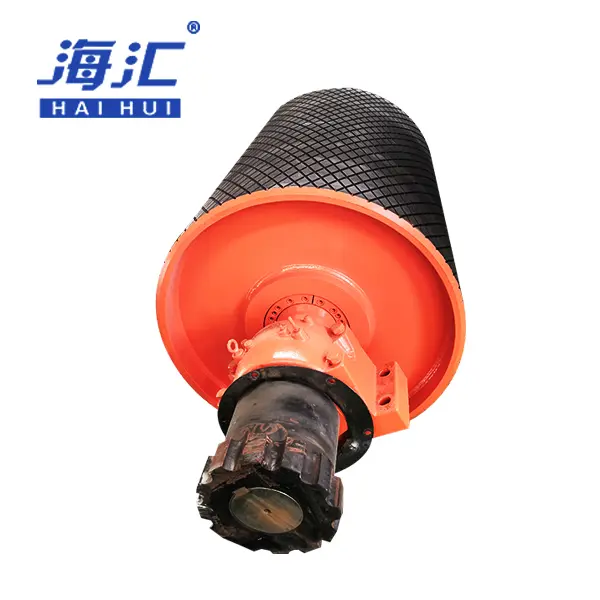
5 Factors To Check Before Ordering a Head Pulley
When sourcing a head pulley, small details make or break your conveyor’s reliability. Buyers chasing better pricing often overlook specs that affect safety, belt life, and compliance. Here’s a practical breakdown to help you specify a head pulley with confidence and zero guesswork.
Material Selection: Carbon Steel vs. Alloy Steel vs. Stainless Steel
Choosing the right material shapes performance and lifespan. For head pulleys, compare core material options carefully:
- Carbon Steel (Q235B, EN8): High tensile strength, impact resistance, cost-effective for standard drives.
- Alloy Steel (42CrMo, EN19): Higher fatigue resistance for heavy-duty, high-tension drives.
- Stainless Steel (304, 316): Corrosion resistance for chemical plants, food processing, and coastal environments.
| Material | Typical Application | Allowable Bending Stress (MPa) | Notes |
|---|---|---|---|
| EN3 / 070M20 | Light-duty, non-drive | 43 | Low cost, limited fatigue life |
| EN8 / 080M40 | Standard drive and non-drive | 55 | Common general-purpose choice |
| EN19 / 709M40 | Heavy-duty drives | 83 | High tension, frequent starts |
| 42CrMo / 4140 | Mining-grade drives | 90–100 | Highest fatigue resistance |
If you’re buying a head pulley for a mining conveyor, strength matters more than finish. For chemical or food-grade applications, stainless steel wins on corrosion resistance.
Capacity & Gauge: Diameter, Face Width, Shaft Thickness Considerations
When ordering a head pulley, sizing errors cost money fast. Check diameter, face width, and shaft thickness against real transport needs. The pulley diameter directly affects belt bending stress and belt life.
Minimum pulley diameter recommendations based on belt type:
| Belt Breaking Load (N/mm) | Textile Core Belt – Motorized Pulley Ø (mm) | Textile Core – Direction Change (mm) | Steel Core – Motorized Pulley Ø (mm) | Steel Core – Direction Change (mm) |
|---|---|---|---|---|
| 200 | 200 | 160 | – | – |
| 315 | 315 | 250 | – | – |
| 500 | 500 | 400 | – | – |
| 800 | 800 | 630 | 630 | 500 |
| 1000 | 1000 | 800 | 630 | 500 |
| 1250 | 1250 | 1000 | 800 | 630 |
| 1600 | 1400 | 1250 | 1000 | 800 |
| 2000 | – | – | 1000 | 800 |
Reference: Rulmeca technical documentation – minimum pulley diameters recommended for belt conveyors
A pulley that is too small for the belt type causes delamination of belt layers and laceration of the reinforcing fabric. The minimum diameter depends on belt construction and carcass thickness.
Lagging Compound Selection: Rubber, Ceramic, or FRAS
Lagging is the friction layer between the pulley and belt. The wrong compound accelerates belt cover wear or fails to grip in wet conditions. The right one extends both pulley and belt life.
Lagging selection by condition:
| Condition | Recommended Compound | Pattern | Typical Hardness (Shore A) |
|---|---|---|---|
| Dry, clean, general bulk | SBR or natural rubber | Plain or diamond | 60–70 |
| Wet, muddy, outdoor | SBR or EPDM | Herringbone | 60–70 |
| High abrasion, sharp ore | Abrasion-resistant rubber | Plain or grooved | 65–75 |
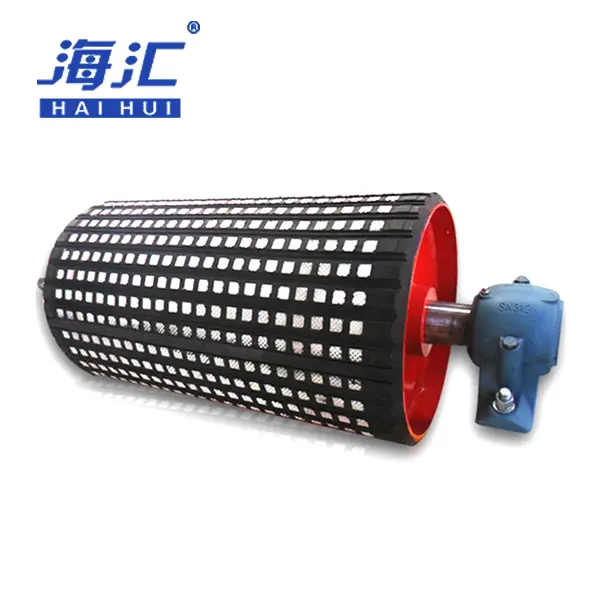
| High tension, slip-prone | Ceramic embedded | Checkered or full | 80+ |
| Oily, solvent-exposed | Nitrile (NBR) | Plain | 60–70 |
| Fire-risk underground | FRAS compound | Plain or grooved | 60–70 |
CEMA recommends that lagging be used for all drive pulleys, particularly those in high-tension applications. Non-driving pulleys, especially on the carrying side of the belt, should be lagged in abrasive environments .
A 60-durometer lagging is the industry standard for general drive applications, balancing grip and wear life. Herringbone grooves channel water away and are directional—install them pointing in the direction of belt travel. Diamond grooves suit reversing conveyors. Ceramic lagging embeds hard tiles in a rubber matrix for maximum traction in wet, high-tension drives, but it can wear the belt cover if the application is mismatched .
Bearing Protection: Seals, Housings, and Lubrication
Bearing failure is the most common reason a head pulley is pulled from service. The bearing environment determines how long it lasts.
Bearing selection considerations:
| Factor | Recommended Practice |
|---|---|
| Bearing type | Spherical roller bearings for radial and axial load capacity |
| Clearance | C3 or C4 for thermal expansion |
| Sealing | Labyrinth seals for dust; contact seals for washdown |
| Housing | Cast or fabricated, with grease ports and drain paths |
| Lubrication | Lithium EP2 or polyurea; match temperature range |
| Minimum B10 life | 60,000 hours or higher for critical drives |
For dusty environments like cement plants or coal handling, multi-stage labyrinth seals keep fine particles out of the bearing cavity. For washdown or outdoor installations, contact seals or combined labyrinth-contact seals resist water ingress .
Regulatory Compliance and Documentation
Compliance isn’t optional; it’s survival in industrial procurement.
Nested checklist for regulated shipments:
- Regulatory Certification: UN-rated marking where applicable; drop-test verification documents for hazardous environments.
- Transport Approval: DOT packaging code alignment for export shipments.
- Hazard Communication: Proper labeling for fire-risk applications (FRAS lagging documentation).
If you’re exporting head pulleys internationally, documentation should match packaging specs exactly. Haihui supports clients with compliance-ready paperwork, simplifying customs clearance and hazardous material transport.
Steel Vs. Wing Head Pulleys: Which To Choose?
Choosing between a welded drum pulley and a wing pulley isn’t just shop talk. If you’re sourcing a head pulley, planning a drive station, or comparing replacement options, the configuration shifts cost, lifespan, and maintenance frequency. Here’s a straight-up breakdown to help you pick what actually fits your workload.
Welded Steel Drum Pulleys
When strength matters, the welded drum pulley steps in. Buyers sourcing head pulleys for cement plants or mining operations often lean toward thicker shell options because durability and strength directly affect lifespan.
Key advantages:
- High durability under repeated impact
- Thick shell options for heavy loads
- Protective coatings for added corrosion resistance
Selection logic:
- Select appropriate shell thickness (6–25 mm depending on tension).
- Confirm welded seams and stress relief for industrial-grade strength.
- Match internal coatings with the operating environment.
Welded drum pulleys are common in industrial applications thanks to their reusability. Drop one, and it usually shrugs it off.
For buyers comparing head pulley configurations, here’s a quick data snapshot:
| Property | 6mm Shell | 10mm Shell | 16mm Shell | 25mm Shell |
|---|---|---|---|---|
| Weight (kg, Ø800mm × 1400mm) | 420 | 680 | 1050 | 1600 |
| Tensile Strength (MPa) | 235 | 235 | 235 | 235 |
| Impact Resistance | Medium | High | Very High | Extreme |
| Corrosion Resistance* | Coated | Coated | Coated | Coated |
| Typical Use | Light aggregate | Coal, cement | Heavy ore | Mining, high tension |
*Depends on applied coatings and environment.
If your head pulley needs muscle, steel keeps things steady and predictable.
Wing Pulleys for Sticky Materials
Wing pulleys use steel bars or fins welded to the shaft instead of a solid shell. Material falls through the gaps, so buildup sheds naturally. That makes it a practical choice when the belt carries wet, sticky, or fibrous loads.
Key advantages:
- Self-cleaning action reduces carryback
- Lower rotating mass than solid drum equivalents
- Simple field inspection without removing the belt
In practical conveyor design:
- The wing structure supports the belt but doesn’t trap material.
- Gaps allow fines and moisture to drop away.
- The open design suits return-side and drive positions on challenging belts.
Many aggregate and recycling operations choose wing pulleys for the head position when carryback is a chronic problem. Haihui manufactures wing pulleys with wear-resistant bar stock and reinforced end plates to handle the impact of lumpy feed.
Meeting Heavy-Duty Standards For Head Pulleys
Choosing the right head pulley isn’t just about price. For critical conveyors, safety rules matter, documentation matters, and smart design keeps belts running from the drive to the discharge.
CEMA Load Ratings and Shaft Fatigue Requirements
When sourcing head pulleys, material choice sets the tone. Industrial buyers expect documented load ratings, verified shaft fatigue analysis, and certified weld quality.
Key material checkpoints include:
- Verified shaft fatigue calculation per CEMA B105.1
- Approved lagging specification for the operating environment
- Proven deflection control at the bearing seats
Shaft sizing performance table for head pulleys:
| Shaft Material | Allowable Bending Stress (MPa) | Typical Application | Fatigue Life Factor |
|---|---|---|---|
| EN3 / 070M20 | 43 | Light-duty, non-drive | 1.0 (baseline) |
| EN8 / 080M40 | 55 | Standard drive | 1.3 |
| EN19 / 709M40 | 83 | Heavy-duty drive | 2.0 |
| 42CrMo / 4140 | 90–100 | Mining-grade drive | 2.3 |
For bulk buyers of head pulleys, documentation should align with current CEMA standards. That includes load rating verification and shaft fatigue calculation.
Review checklist:
- Review shaft fatigue analysis data.
- Confirm batch-level weld trace records.
- Conduct third-party compliance checks where required.
Brands like Haihui provide head pulleys engineered for heavy industrial use, balancing safety and durability without driving up total cost.
Hygienic Design: Seamless Construction & Gasketed Closures
Clean design keeps contamination out. In the world of head pulleys for food or chemical conveyors, build quality often decides audit outcomes.
Core design advantages include:
- Seamless construction from deep drawing where applicable
- Smooth surfaces for easy cleaning
- Secure gasketed lids for enclosed applications
Hygiene control happens in layers:
- Structural integrity: One-piece body forming; reduced weld exposure.
- Closure reliability: Food-grade gasket materials; pressure-tested double seams.
- Operational safety: Tamper-evident locking rings; moisture barrier validation.
This kind of hygienic design directly supports contamination prevention, especially for dairy powders, syrups, and ready-mix ingredients conveyed on belt systems. For buyers sourcing head pulleys at scale, even small design flaws can snowball into recalls.
Certification & Traceability: ISO 9001, CEMA, and Weld NDT
Paperwork can feel boring, but it protects your business. Reliable head pulleys should come backed by ISO 9001 certification, validated weld NDT records, and testing validation from agencies like SGS.
Compliance works through layered control:
- Manufacturing audits: Material declaration files; batch-coded traceability systems.
- Production monitoring: In-line weld inspection; random dimensional checks.
- Post-production validation: Documentation archiving; external supplier audits.
According to CEMA, welded steel conveyor pulleys have been in common use since the 1930s, and the standard establishes load ratings, allowable dimensional variations, and permissible crown dimensions . Manufacturers such as Haihui integrate serialized coding and export-ready compliance files, making large-scale procurement of head pulleys smoother and audit-ready.
In short, verified materials, hygienic engineering, and documented compliance turn ordinary head pulleys into dependable heavy-duty solutions.
Head Pulley Specifications at Haihui
Haihui Environmental Protection Equipment Co., Ltd. is a manufacturer of belt conveyor pulleys, rollers, and structural components based in Rizhao, Shandong, China. The company operates 12 intelligent production workshops with an annual output capacity of 15,000 sets of equipment and holds 168 authorized patents, including 15 invention patents.
Product scope: welded steel drum pulleys, wing pulleys, head pulleys, bend pulleys, and complete pulley assemblies for belt conveyors. Belt widths from 400 mm to 2,400 mm; pulley diameters from 200 mm to 1,600 mm. Materials include Q235 carbon steel and custom alloy steels for high-tension applications.
Quality systems: ISO 9001, ISO 14001, ISO 45001, and ISO 50001 certified. Products are manufactured to CEMA, AS, DIN, ISO, and GB standards.
Export markets: Products are exported to the United States, Russia, Canada, Australia, Egypt, South America, the Middle East, and Southeast Asia. Haihui has established long-term partnerships with major steel and paper producers including Shandong Iron and Steel Group, Yongfeng Iron and Steel, Nine Dragons Paper, and Sun Paper.
Service capability: Professional sales team with 24-hour response, sample delivery in 1–2 days, OEM customization for products, logos, and packaging, and small-quantity order acceptance for urgent requirements.
FAQ about Head Pulleys
Q: What is a head pulley on a belt conveyor?
A: A head pulley is the pulley located at the discharge end of a belt conveyor. It is typically the drive pulley that transmits torque from the motor and gearbox to the belt. It can also be a non-drive pulley that redirects the belt at the head end.
Q: What is the difference between a head pulley and a tail pulley?
A: A head pulley is at the discharge end and usually drives the belt. A tail pulley is at the loading end and redirects the belt back toward the drive. Tail pulleys can also be take-up pulleys that maintain belt tension.
Q: What is the purpose of lagging on a head pulley?
A: Lagging increases friction between the pulley and belt, preventing slip. It also protects the pulley shell from wear and can improve belt tracking. Common lagging materials include rubber, ceramic, and polyurethane.
Q: How do I choose the right lagging for my head pulley?
A: Choose based on operating conditions. Plain rubber lagging suits dry, clean environments. Herringbone or diamond grooved rubber works in wet conditions. Ceramic lagging provides maximum grip for high-tension drives. FRAS lagging is required for fire-risk applications.
Q: What shaft material should I specify for a heavy-duty head pulley?
A: EN19 (709M40) and 42CrMo (4140) are common choices for heavy-duty drive pulleys. EN19 offers allowable bending stress around 83 MPa, while 42CrMo can reach 90–100 MPa with appropriate heat treatment.
Q: How is shaft diameter calculated for a head pulley?
A: Shaft diameter is governed by the largest of three criteria: torsion-based diameter (using allowable shear stress), bending-based diameter (using equivalent bending moment), and deflection-based diameter (limiting slope at the bearing seat to 0.0015–0.0017 radians).
Q: What is the minimum pulley diameter for a given belt?
A: Minimum pulley diameter depends on belt carcass material and thickness. Rulmeca technical data recommends different diameters for textile and steel cord belts depending on breaking load. For a textile belt with 800 N/mm breaking load, a motorized pulley of at least 800 mm diameter is recommended .
Q: Can head pulleys be repaired on site?
A: Lagging can be replaced on site using cold-bond or slide-lagging methods. Bearing replacement is possible with proper tools and access. Weld repairs on the shell or end discs should be performed in a workshop with NDT capabilities.
Q: What is the typical service life of a head pulley?
A: With proper specification and maintenance, a welded steel head pulley can last 10–15 years. Lagging typically requires replacement every 2–5 years depending on material abrasiveness and operating conditions. Bearing life depends on sealing, lubrication, and load.
Q: Does Haihui manufacture head pulleys for all conveyor applications?
A: Haihui manufactures head pulleys for heavy-duty industrial conveyors in cement, mining, steel, power, port, chemical, and paper industries. We do not supply portable or light-duty conveyors used in warehouses or retail settings.
References
- CEMA – Pulley Lagging. Conveyor Equipment Manufacturers Association, Belt Book Chapter 8. cemanet.org
- Superior Industries – Conveyor Pulley Lagging: Materials, Patterns, and Applications. superior-ind.com
- Thomas Conveyor & Equipment – Pulley Lagging catalog: vulcanized lagging, MSHA-approved compounds, and lagging thickness requirements
- Rulmeca – Technical Information: Project and Design Criteria for Belt Conveyors. Minimum pulley diameters recommended for belt conveyors.
- CEMA Standard B105.1-2015 – Specifications for Welded Steel Conveyor Pulleys with Compression Type Hubs. ANSI/CEMA.
- CSBP – Engineering Standard ES-14-403-03: Pulley Shaft Bearings. Minimum B10 life of 60,000 hours.
- Continental Conveying Solutions – Pulley Strip Lagging Portfolio: lagging types, ceramic coverage, and bonding systems.
- REMA TIP TOP – Pulley Lagging & Sleeves product overview.
- ISO 254:2011 – Belt drives — Pulleys — Quality, finish and balance.
- Haihui Environmental Protection Equipment Co., Ltd. – Company profile and product documentation. haihuiconveyor.com
- BHEL – Technical Specifications for Conveyor Systems: head pulley hoods, scraper assemblies, and service factors.
- Belt Conveyors and Belt Elevators – Historical reference: snub pulleys, crowning, and pulley diameter recommendations.
- Rizhao Daily – Haihui Environmental overseas orders grow, production capacity utilization exceeds 95%.


 English
 العربية
 Русский
 Español
 Português do Brasil