Belt Filter Press for Industrial Sludge Dewatering and Solid-Liquid Separation

Product Details

Belt Filter Press for Industrial Sludge Dewatering and Solid-Liquid Separation
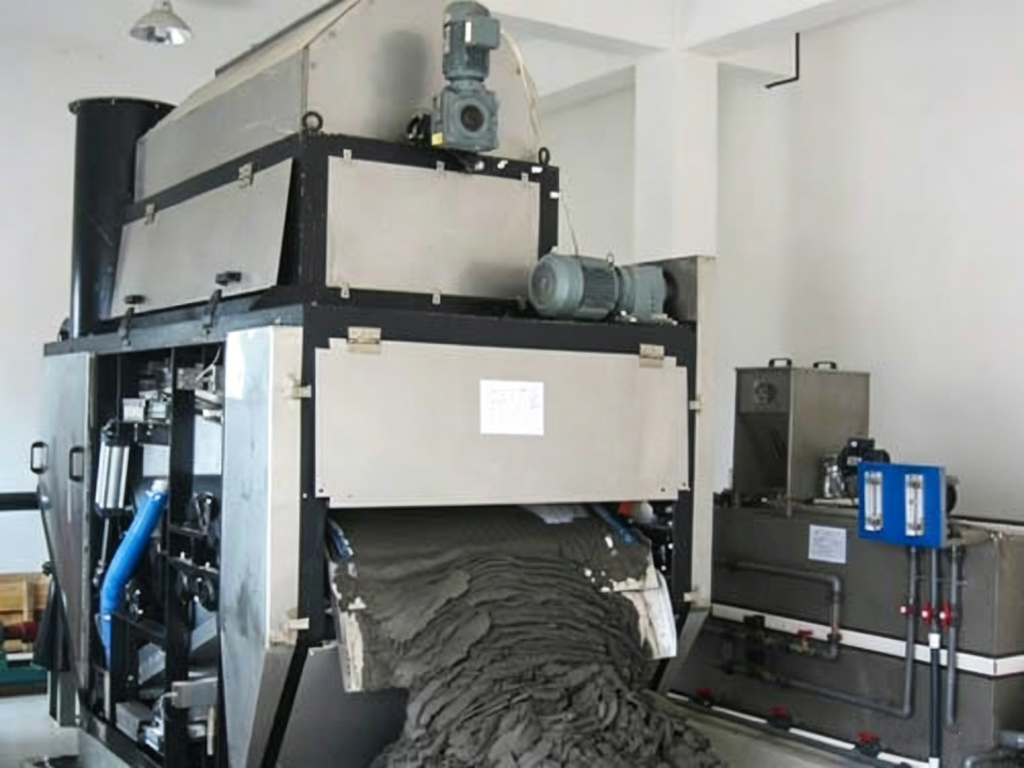
The belt filter press offers several key advantages: high pressure, strong dewatering capability, a high degree of automation, and simple operation. The discharged material achieves a moisture content of less than 78%. This equipment is widely used for sludge dewatering in municipal wastewater treatment and across many industries, including textile printing and dyeing, electroplating, papermaking, leather processing, brewing, food processing, coal washing, petrochemicals, chemicals, metallurgy, pharmaceuticals, and ceramics.

How a Belt Filter Press Works

The belt filter press uses a series of rollers and two filter belts to squeeze water out of sludge. The process typically involves three stages. First, gravity drainage removes free water as sludge flows onto the moving belt. Second, a low-pressure wedge zone gradually compresses the sludge, preparing it for higher pressure. Third, high-pressure rollers apply increasing force to extract additional water. The final product is a dry cake that is easy to handle and dispose of.

Key Advantages

High Pressure and Strong Dewatering

The roller arrangement creates progressively higher pressure as sludge moves through the press. This mechanical pressing removes more water than gravity thickening alone. The result is drier cake, which reduces disposal weight and transportation costs.

High Automation and Simple Operation

Modern belt filter presses are equipped with automatic controls for belt tension, tracking, and wash water. Operators can monitor and adjust parameters from a central panel. Automatic belt tracking systems prevent misalignment, reducing downtime. Self-cleaning spray bars keep belts porous, maintaining consistent performance.

Low Discharge Moisture

Achieving discharge moisture below 78% is significant. Drier sludge reduces the volume of material sent to landfills or incinerators. It also lowers fuel consumption if the sludge is dried further or burned.

Application Versatility

The belt filter press handles biological sludge from municipal plants, chemical sludge from industrial processes, fibrous sludge from paper mills, oily sludge from refineries, and inorganic sludge from metal finishing. The same basic design works across these applications, with adjustments to belt type, roller configuration, and chemical conditioning.

Maintenance Considerations

Regular belt cleaning, roller bearing lubrication, and tracking sensor calibration are required. Belt life typically ranges from 2,000 to 5,000 operating hours, depending on sludge abrasiveness and cleaning effectiveness.
Related Products

Printing and Dyeing Wastewater Technology for Color and COD Removal

Printing and Dyeing Wastewater Technology for Color and COD Removal Product Details Printing and Dyeing Wastewater Technology for Color and COD Removal Key Technologies The anaerobic hydrolysis and acidification stage modifies the molecular structure of complex organic compounds. Large, non-biodegradable dye molecules are broken down into smaller, more readily biodegradable intermediates. This transformation creates favorable…

HZIC Anaerobic Internal Circulation Reactor for Industrial High-Strength Wastewater Treatment

HZIC Anaerobic Internal Circulation Reactor for Industrial High-Strength Wastewater Treatment Product Details HZIC Anaerobic Internal Circulation Reactor for High-Strength Wastewater Treatment Introduction to the HZIC Anaerobic Reactor The HZIC anaerobic reactor is a third-generation anaerobic treatment system developed from research on the Upflow Anaerobic Sludge Blanket (UASB) reactor. It uses a two-stage three-phase separator to…

MBR Membrane Bioreactor for Domestic Sewage Treatment and Water Reuse

MBR Membrane Bioreactor for Domestic Sewage Treatment and Water Reuse Product Details MBR Membrane Bioreactor for Domestic Sewage Treatment and Water Reuse Technology Overview The Membrane Bioreactor (MBR) process combines biological wastewater treatment with membrane separation technology. Wastewater entering the reactor undergoes biological treatment where organic pollutants are broken down and converted. After biological treatment,…

Flue Gas Desulfurization Wastewater Treatment System for Coal-Fired Power Plants

Flue Gas Desulfurization Wastewater Treatment System for Coal-Fired Power Plants Product Details Flue Gas Desulfurization Wastewater Treatment System for Coal-Fired Power Plants The flue gas desulfurization (FGD) wastewater treatment system is designed using optimized principles and methods. It offers high treatment efficiency, low operating costs, and low energy consumption. This system is widely used for…

Medium and High Concentration Wastewater Treatment for Industrial Organic Loads

Medium and High Concentration Wastewater Treatment for Industrial Organic Loads Product Details Haihui Water Treatment Division: Medium to High Concentration Wastewater Treatment for Industrial Organic Loads The Haihui Water Treatment Division offers a complete range of services including consulting and design, proprietary equipment manufacturing, engineering installation, process commissioning and startup, operator training, and facility operation…

Municipal Wastewater Treatment System for Domestic Sewage and Industrial Discharge

Municipal Wastewater Treatment System for Domestic Sewage and Industrial Discharge Product Details Haihui Water Treatment Division: Comprehensive Services for Industrial and Municipal Wastewater The Haihui Water Treatment Division offers a full range of services including consulting and design, proprietary equipment manufacturing, engineering installation, process commissioning and startup, operator training, and facility operation and maintenance under…