
Comprehensive Guide to Engineering and Mining Conveyor Pulleys
- Equipment Introduction and Core Purpose
- Technical Classifications and System Construction
- Operating Principle
- Key Performance Advantages
- Industrial Standards and Specifications
- Engineering Design Formulas and Technical Values
- Industrial Operations, Maintenance, and Safety Protocols
- Intelligent Monitoring and Failure Mitigation
- Technical Trends and Future Development
- References and Data Sources
Equipment Introduction and Core Purpose
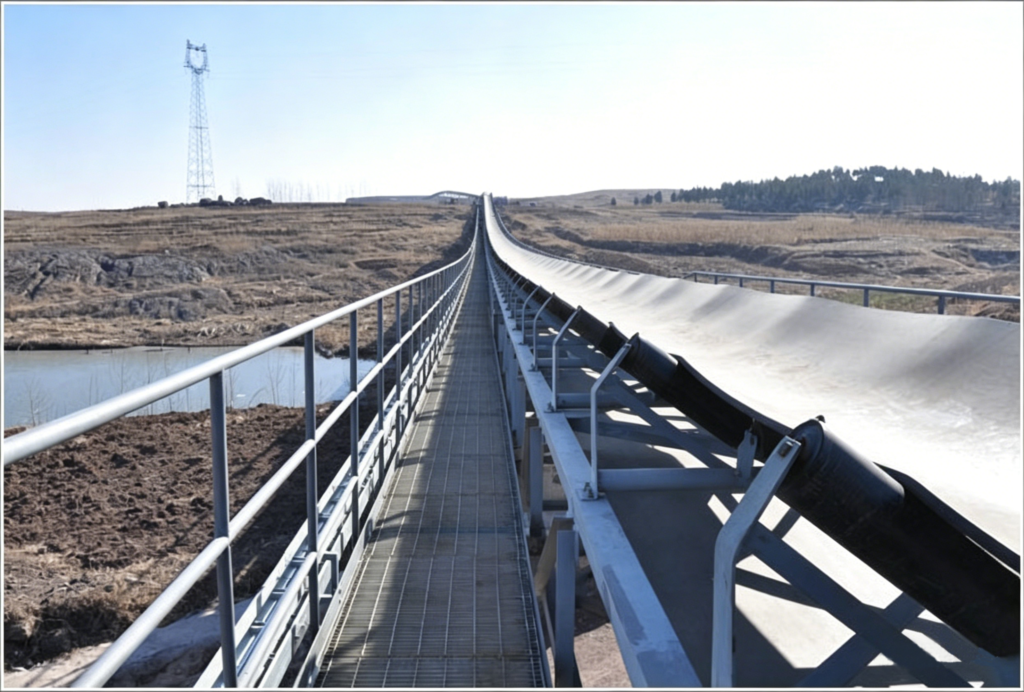
A mining belt conveyor is a type of continuous material transport equipment that works based on the principles of friction drive. This machine is a reliable tool used to transport bulk materials or bagged goods across heavy industries, including coal mining, metallurgy, and chemical processing [1].
The equipment is designed to operate in severe environments, with a standard working temperature range between -10°C and +40°C. Additionally, the temperature of both the surrounding environment and the transported materials must be kept between -10°C and +50°C [8]. It is ideal for moving low-abrasion materials such as coal, sand, gravel, and cement. While classic rubber belts remain common, modern systems also utilize alternative materials such as polyvinyl chloride (PVC) and polyurethane (PU) to match specific operational requirements [7].
Technical Classifications and System Construction
Mining belt conveyors are built from several core assemblies: a drive unit, pulleys (drums), idlers (rollers), and a dedicated braking or backstop system. Depending on the structural reinforcement of the belt, the equipment is divided into three primary industrial types [3]:
- Fabric core belt conveyors
- Steel cord belt conveyors
- Steel wire rope-driven belt conveyors
The equipment layout can be modified to fit challenging environments, such as steep underground inclined shafts or volatile zones requiring strict dust-proofing and explosion protection. Advanced models also feature integrated scrap collection mechanisms to reduce material spillage, automated power cord storage reels to improve electrical safety [1], specialized mechanisms to prevent belt tearing from returned coal, and automatic tension adjustment systems [9-10].
Standard System Components
For fixed belt conveyor systems, the construction is broken down into seven functional sections:
| System Section | Primary Components & Functional Description |
| 1. Drive Unit | Includes the electric motor, high-speed coupling, gear reducer, and low-speed coupling mounted on a welded steel base. Available in left-hand or right-hand configurations, or can use motorized pulleys. |
| 2. Pulley Assembly | Divided into driving pulleys (motorized drums) and return/bend pulleys. |
| 3. Idler Assembly | Includes troughed idlers (for carrying bulk material), parallel idlers, self-aligning idlers (for tracking control), and impact idlers (at loading zones). |
| 4. Discharge Unit | Uses fixed plow dischargers or electric discharge cars to unload materials. |
| 5. Cleaning System | Features spring-loaded scrapers installed below the head pulley and empty-section cleaners along the return path. |
| 6. Braking System | Utilizes roller backstops, belt-type backstops, or specialized non-return motorized pulleys to prevent backward runaway. |
| 7. Accessories | Includes protective enclosures, guiding chutes, and material hoppers. |
Operating Principle
The core driving force of a mining belt conveyor relies completely on mechanical friction.
[Drive Unit Powers Driving Pulley]
               │
               ▼ (Friction Force Generated)
[Conveyor Belt is Pulled into Motion]
               │
               ▼ (Supported by Idlers & Structural Frame)
[Continuous Transport of Bulk or Packaged Cargo]
The drive unit rotates the main driving pulley, which grips and pulls the conveyor belt using the friction generated between their contact surfaces. The intermediate framework, along with its structured idler sets, supports the moving belt. The belt acts simultaneously as both the traction mechanism (pulling the load) and the carrying bed (holding the cargo), allowing for the uninterrupted movement of materials over long distances [7].
Key Performance Advantages
Mining belt conveyors provide distinct operational benefits that make them a preferred choice over alternative haulage systems [4, 7]:
- High Efficiency and Low Wear: The machinery runs smoothly with low power consumption and minimal mechanical resistance, protecting friable cargo from structural degradation or crushing.
- Long-Distance Capacity: Systems are highly scalable. Transport distances can span from a few meters up to more than 10 kilometers, operating effectively inside narrow underground tunnels or across elevated open-air gantries.
- Simplified Automation: The structural layout easily integrates with programmable logic controllers (PLCs) and automated safety networks, minimizing manual labor requirements.
Industrial Standards and Specifications
Conveyor designs comply with rigorous manufacturing and safety frameworks to ensure compatibility across mines and processing plants.
Dimensional Parameters (MT/T 1216—2024)
The industrial standard Belt Conveyors for Coal Mines—Basic Parameters and Dimensions (MT/T 1216—2024) governs systems used in underground mines, open-pit mines, and coal preparation plants [5]. It dictates standard belt widths, operating speeds, and power ratings:
- Standard Belt Widths ($B$): 500, 600, 800, 1000, 1200, 1400, and 1600 mm [7].
- Available Belt Speeds ($v$): 0.63, 0.8, 1.0, 1.25, 1.6, 2.0, 2.5, 3.15, and 4.0 m/s.
- Drive Power Ratings ($P$): Scalable from 1.5 kW up to 800 kW [1].
- Throughput Capacity ($Q$): Rated to handle ranges from 50 to 15,000 tons per hour [8].
Safety Regulations (GB 22340-2008)
The national safety standard Belt Conveyors for Coal Mines—Safety Regulations (GB 22340-2008) sets strict boundaries for design, manufacturing, and installation [6]. This standard applies to underground coal operations and hazardous, explosion-prone open-pit facilities. Note that this standard excludes steel wire rope-driven systems and is currently undergoing an official 12-month revision process to integrate modern technical requirements [6].
Engineering Design Formulas and Technical Values
When designing or ordering a mining belt conveyor, engineers use specific mathematical relationships to ensure the motor can overcome operating resistance and deliver the required throughput.
1. Material Throughput Calculation
The volumetric and mass capacity of a troughed belt conveyor is determined using the standard cross-sectional area formula:
$$Q = 3600 \cdot A \cdot v \cdot \rho \cdot C_\beta$$
Where:
- $Q$ = Mass throughput capacity ($\text{t/h}$)
- $A$ = Cross-sectional area of the material on a troughed belt ($\text{m}^2$)
- $v$ = Belt speed ($\text{m/s}$)
- $\rho$ = Bulk density of the material ($\text{t/m}^3$, typically ranging from $1.0 \text{ to } 2.5 \text{ t/m}^3$ for mined ore)
- $C_\beta$ = Slope reduction factor (dimensionless, accounts for reduced area when the conveyor operates at an incline angle $\beta$)
2. Drive Operating Power Estimation
To calculate the fundamental drive power required at the driving pulley to move the material horizontally and lift it vertically, engineers apply the following empirical formula [8]:
$$P = \frac{C \cdot f \cdot L \cdot (G_b + G_m) \cdot v + Q \cdot H}{367}$$
Where:
- $P$ = Required drive shaft power ($\text{kW}$)
- $C$ = Conveyor length coefficient (dimensionless empirical factor, compensates for secondary resistances in short belts; see table below)
- $f$ = Artificial friction factor of the idlers (typically $0.018 \text{ to } 0.030$ for standard mining conditions)
- $L$ = Total center-to-center conveyor length ($\text{m}$, ranging up to $500\text{m}$ for single standard units [7])
- $H$ = Total vertical lifting height ($\text{m}$)
- $G_b$ = Combined linear mass of the moving belt and rotating idler parts ($\text{kg/m}$)
- $G_m$ = Linear mass of the material carried on the belt ($\text{kg/m}$, calculated as $\frac{Q}{3.6 \cdot v}$)
Empirical Values for Length Coefficient ($C$)
The table below provides standard empirical values for the conveyor length coefficient ($C$) based on the overall transport distance:
| Conveyor Length L (m) | Length Coefficient C (Empirical Value) |
| $\le 10$ | 9.00 |
| 20 | 5.30 |
| 50 | 2.80 |
| 100 | 1.92 |
| 200 | 1.45 |
| $\ge 500$ | 1.15 |
Industrial Operations, Maintenance, and Safety Protocols
Safe operation of high-power mining conveyors requires strict adherence to operating rules and continuous monitoring.
Core Operating Procedures
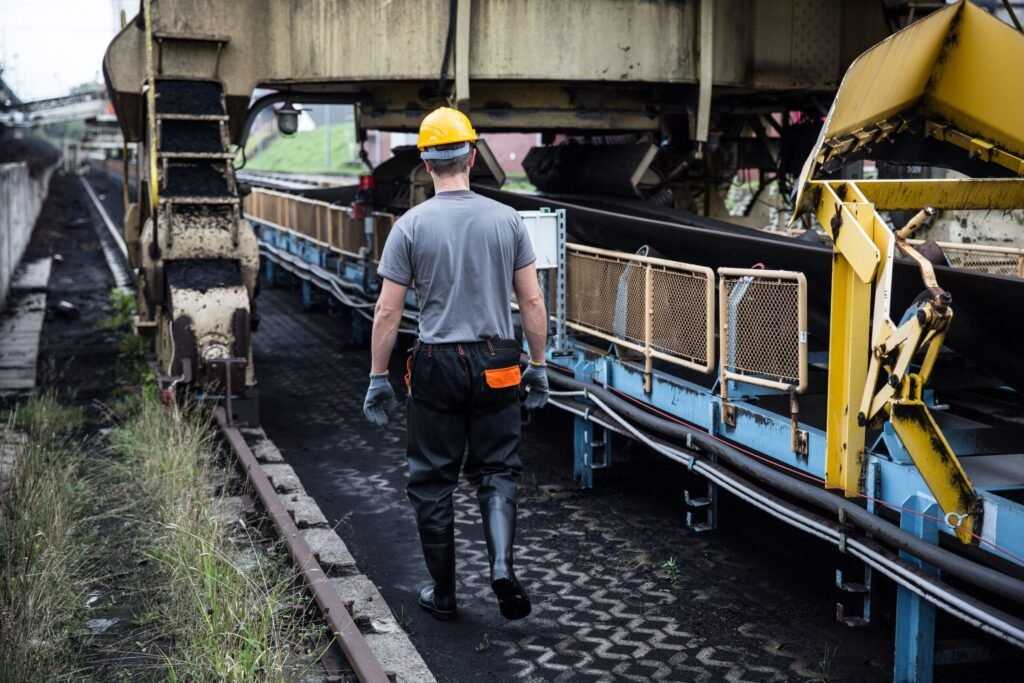
- No-Load Commencement: Conveyor systems must always be started with an empty belt (no-load state). Material feed chutes should only begin discharging cargo onto the belt once the system has reached its full operating speed [8].
- Interlocking Shutdown Sequence: Prior to stopping the conveyor, upstream material feeding must be completely cut off. The belt must run until all remaining surface material has been fully discharged.
- Emergency Stop Mandate: Operators must immediately trigger an emergency stop if foreign metal parts, oversized timber, or large coal boulders are detected on the moving belt to prevent severe structural damage [12]. Personnel are strictly banned from riding or walking on the conveyor belt at all times [8].
Routine Preventive Maintenance
To prevent component failure, maintenance teams must follow a structured schedule:
- Bearing Lubrication: Maintain clean lubrication across all idler bearings and pulley shaft blocks to minimize frictional heat.
- Slippage Interventions: If the belt slips against the drive pulley, technicians must inspect the system load, check the starting speed ramp, verify belt tension via the take-up unit, and confirm that pulley bearings are turning freely [2]. Safety Warning: It is strictly forbidden to pull or push a slipping belt manually while the motor is energized [8].
- Belt Alignment Audits: If the belt wanders off-center (tracking error), the conveyor must be stopped and adjusted using self-aligning idlers or by recalibrating the pulley alignment axes [11].
Intelligent Monitoring and Failure Mitigation
Modern mines use electronic control networks to reduce accidents like belt tears or fires [11].
Digital Supervision Systems
Advanced installations deploy integrated control frameworks, such as the KJ1038 Mining Belt Conveyor Transport Communication and Control System [12]. This architecture provides:
- Real-time video surveillance at material transfer stations.
- Automated sensors to detect oversized debris or iron contaminants.
- Audio-visual alarms and safety guards at head and tail pull zones to shield workers from moving parts [12].
Troubleshooting Matrix for Common Failures
The table below details common conveyor faults along with their root causes and technical solutions:
| Common Fault | Root Engineering Causes | Technical Corrections & Diagnostics |
| Belt Slippage | • Excessive material overloading • Slow start acceleration curves • Insufficient belt tension • Damaged pulley bearings [2] | • Reduce upstream feed rate • Optimize soft-start parameters • Adjust gravity or hydraulic take-up units • Replace seized bearing cartridges |
| Belt Tracking Error (Wandering) | • Out-of-round pulleys • Poor structural rigidity of the frame • Misaligned idler frames • Unequal friction or off-center material loading [11] | • Verify pulley roundness parameters • Use laser alignment tools to check the frame centerline • Adjust the positioning angle of the idlers • Correct the feed chute alignment |
| Material Rollback Tearing | • Sharp rock chunks trapped in return paths • Material sliding backward down steep inclines [9] | • Install specialized impact-absorbing rubber tearing protection units • Mount secondary v-plow belt cleaners [9] |
Technical Trends and Future Development
The engineering design of mining belt conveyors continues to advance toward large-scale capacities, extended transport distances, automated sorting capabilities, reduced energy consumption, and lower environmental pollution.
Key innovations include specialized herringbone or chevron surface patterns to prevent wet material slippage [2], heavy-duty impact-absorbing rubber tear-prevention units [9], and smart tensioning systems that automatically adjust belt tension based on real-time motor torque [10]. When combined with automated remote control hubs like the KJ1038 system, modern belt conveyors operate as fully integrated, self-monitoring utility networks [12].
References and Data Sources
- [1] Utility Model Patent: A Specialized Mining Belt Conveyor System, Tianyancha Database, Published April 25, 2024.
- [2] Technical Product Documentation, Shibang Industry & Technology Group Co., Ltd., Updated January 8, 2026.
- [3] Engineering Classification Index: Mining Belt Conveyors, China National Knowledge Infrastructure (CNKI) Database, February 18, 2026.
- [4] Technical Advantage Report on Bulk Material Transport, Shibang Industry & Technology Group Co., Ltd., February 21, 2014.
- [5] Chinese Industrial Standard: Belt Conveyors for Coal Mines—Basic Parameters and Dimensions (MT/T 1216—2024), State Administration for Market Regulation, Released December 25, 2024.
- [6] National Standardization Project Notice (Project No. 20251053-Q-627), State Administration for Market Regulation, Issued April 30, 2025.
- [7] Product Specification Catalog: Heavy-Duty Mining Belt Conveyors, Made-in-China Industrial Database, February 2, 2026.
- [8] Engineering Specification Sheet: DTII Long-Distance Overland Mining Belt Systems, Made-in-China Industrial Database, December 25, 2025.
- [9] Quality Control Innovation Report: Anti-Tearing Systems for High-Inclined Coal Transport, Shandong Energy Group QC Division, November 28, 2022.
- [10] Utility Model Patent Document: An Adjustable Automatic Tensioning Device for Belt Conveyors, Qichacha Database, February 21, 2026.
- [11] Technical Investigation Report: 15 Engineering Root Causes for Conveyor Belt Tracking Deviations, Henan Kunwei Machinery Manufacturing Co., Ltd., October 20, 2025.
- [12] Operational Safety Directive for Mine Transport Infrastructures, National Mine Safety Administration (Guizhou Bureau Archive), October 9, 2022.
 English
 العربية
 Русский
 Español
 Português do Brasil