
How to Choose High-Quality Conveyor Belt for Your System
- What Is a Conveyor Belt?
- Part One: Classification of Conveyor Belts
- Part Two: How to Select the Right Conveyor Belt?
- Part Three: Conveyor Belt Joints
- Part Four: Safety Factor of Conveyor Belts
- Part Five: How to Select Belt Width and Belt Speed?
- Summary: The Cost and Importance of Conveyor Belts
- Data Sources
What Is a Conveyor Belt?
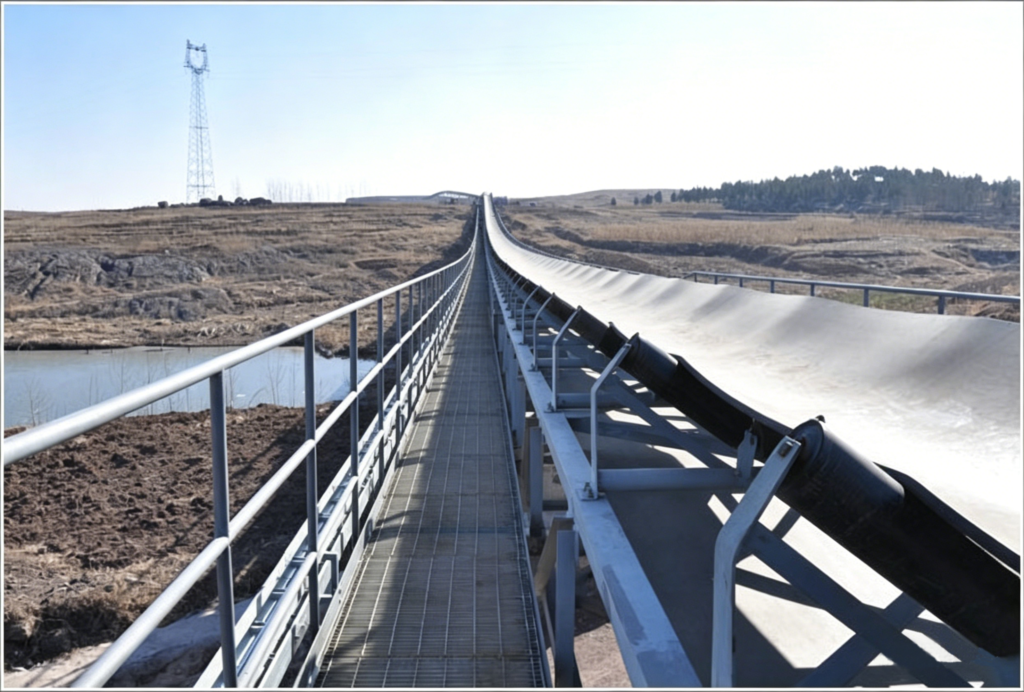
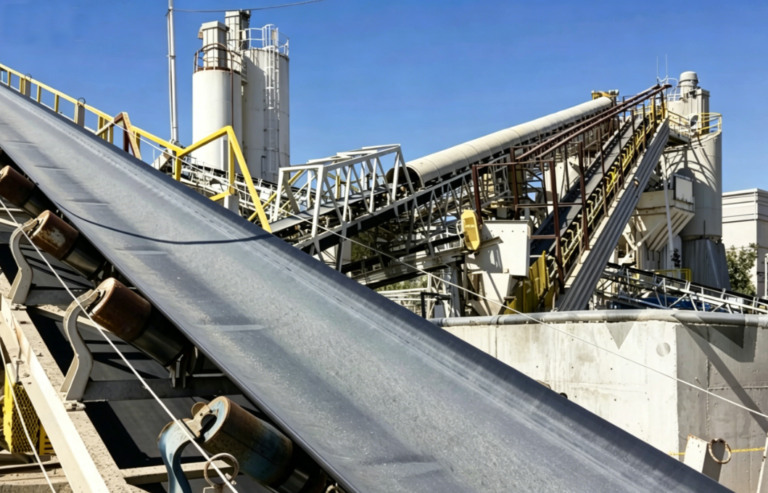
A conveyor belt is a critical component of a belt conveyor system. Its function is to carry materials and transport them to a designated location. The width and length of the conveyor belt depend on the initial design of the belt conveyor and the on-site layout. Selecting the appropriate conveyor belt is crucial for ensuring the efficient and stable operation of the entire conveying system.
Part One: Classification of Conveyor Belts
Two Main Types
Common conveyor belt materials can be divided into two main categories:
Type Material Main Advantages Applications
| Type | Material | Main Advantages | Application Scenarios |
|---|---|---|---|
| Type 1 | Steel cord core | High load capacity, excellent physical and mechanical properties | Large capacity, high-speed transport |
| Type 2 | Nylon, cotton, rubber | Lower cost, good flexibility | Small to medium capacity, slower speed |
Note: Type 2 conveyor belts have lower transport capacity and speed compared to steel cord core belts.
Part Two: How to Select the Right Conveyor Belt?
What factors should be considered when selecting a conveyor belt?
When selecting a conveyor belt, the following factors must be comprehensively considered:
Conveyor length
Conveying capacity
Conveyor belt tension
Characteristics of the material being conveyed
How the material is fed onto the conveyor belt
Operating environment conditions (temperature, humidity, corrosiveness, etc.)
Selection Recommendations for Different Scenarios
Depending on the specific operating conditions, the following principles should be followed when selecting a conveyor belt:
| Operating Condition | Recommended Belt Type |
|---|---|
| Short-distance conveying | Polyester fabric core conveyor belt |
| High capacity, long distance, steep incline, high tension | Steel cord core conveyor belt |
| Material contains large lumps with large drop height at loading point | Impact-resistant and tear-resistant conveyor belt |
| Underground mining | Flame-resistant conveyor belt (mandatory) |
Operating Conditions Recommended Type
Short-distance conveying Polyester fabric-cored conveyor belts
Additional Notes:
The number of fabric layers in multi-layer fabric-cored conveyor belts should generally not exceed 6. If the material being conveyed has special requirements regarding belt thickness, the number of layers may be appropriately increased; however, excessive layers are not recommended, as this may compromise flexibility.

Part Three: Conveyor Belt Joints
Selection of Joint Types
The type of conveyor belt joint should be selected based on the belt type and the characteristics of the conveyor:
The selection of conveyor belt splicing methods should be based on the belt type and conveyor characteristics:
| Belt Type | Recommended Splicing Method | Optional Splicing Method |
|---|---|---|
| Steel cord core conveyor belt | Vulcanized splice (mandatory) | — |
| Layered fabric core conveyor belt | Vulcanized splice (recommended) | — |
| Solid woven conveyor belt | Adhesive splice (recommended) | Mechanical splice |
Steel-cord Conveyor Belts: Depending on the tensile strength grade, a single-stage or multi-stage vulcanized joint may be used.
Part Four: Safety Factor of Conveyor Belts
Selection of Safety Factor
The safety factor of a conveyor belt is a very important parameter. Safety factor = breaking strength of the conveyor belt ÷ maximum tension during actual use. The higher the safety factor, the safer the conveyor belt, but the higher the cost.
| Operating Condition | Recommended Safety Factor Range |
|---|---|
| General belt conveyor | 7 – 9 |
| Conveyor with soft start and soft braking measures | 5 – 7 |
Source: Based on GB/T 50463-2019 “Code for Engineering Design of Belt Conveyors” and general industry standards
Part Five: How to Select Belt Width and Belt Speed?
Selection of Belt Width
Generally speaking, when the belt speed is fixed, the conveying capacity of the conveyor belt increases as the belt width increases.
Principles for selecting belt width:
The conveyor belt must be of sufficient width
Purpose: To ensure that large pieces in the mixture of lumpy and powdery materials being conveyed do not get stuck near the edges of the conveyor belt
The dimensions between the feed chute and the guide chute must ensure that materials of all particle sizes can pass through smoothly without causing blockages
Empirical Formula (Relationship between Belt Width and Maximum Particle Size):
B ≥ 3 × d_max
Where:
B = Belt width (mm)
d_max = Maximum particle size of the material (mm)
Source: CEMA, Belt Conveyors for Bulk Materials, 7th Edition
Example: If the maximum particle size of the material is 200 mm, the belt width should be at least 600 mm. In practice, a width of 650 mm or 800 mm is recommended.
Selection of Conveyor Belt Speed
Selecting the appropriate conveyor belt speed is a complex process that primarily depends on:
The characteristics of the material being conveyed
The required conveying capacity
The tension of the conveyor belt
List of factors affecting the selection of conveyor belt speed:
| Factor | Condition for High Belt Speed | Condition for Low Belt Speed |
|---|---|---|
| Belt width | Wide belt, stable operation | Narrow belt, prone to spillage |
| Conveyor type | Fixed conveyor (high installation quality) | Semi-fixed or portable conveyor |
| Conveying incline | Horizontal or nearly horizontal | The steeper the incline, the lower the speed |
| Conveying direction | Uphill | Downhill (material tends to roll) |
| Conveying distance | Long distance (reduces belt tension) | Short distance (reduces wear) |
Recommendations for selecting belt speed based on material characteristics
| Material Type | Recommended Belt Speed (m/s) | Remarks |
|---|---|---|
| Low abrasion, small particle materials (coal, grain, sand) | 2 – 4 | Suitable for high-speed operation |
| Highly abrasive, large lump, easily damaged materials (large coal, large ore, coke) | 1.25 – 2 | Low speed to reduce wear and breakage |
| Powdery or dust-prone materials | ≤ 1.0 | Prevents dust emission |
| Packaged goods, easily rolling materials, or high sanitation requirement areas | ≤ 1.25 | Prevents material rolling or contamination |
Recommendations for selecting belt speeds based on conveyor layout and unloading methods
| Operating Condition | Belt Speed Limit | Reason |
|---|---|---|
| Long-distance, horizontal conveying | Higher speed optional | High efficiency |
| Steep incline, short distance | Reduce speed appropriately | Prevents material from sliding down |
| Tripper discharge | ≤ 3.15 m/s | Actual incline is large, unsafe |
| Plow discharger | ≤ 2.8 m/s | Additional resistance and wear |
| Steep downhill conveyor | ≤ 3.15 m/s | Prevents uncontrolled material rolling |
The trade-off between bandwidth and conveying speed
Given the same conveying capacity requirements, there are two common design approaches:
Higher bandwidth + lower conveying speed: Smooth operation, but higher equipment costs
Lower bandwidth + higher conveying speed: Lower equipment costs, but more pronounced wear and dust issues
Comparison of the two approaches:
| Option | Advantages | Disadvantages |
|---|---|---|
| Wide belt + low speed | Smooth operation, low wear | High initial investment, heavy equipment |
| Narrow belt + high speed | Low initial investment, light equipment | Rapid wear, high dust generation, frequent maintenance |
When making a final decision, it is necessary to take into account the project budget, environmental requirements and maintenance capabilities.
Summary: The Cost and Importance of Conveyor Belts
The conveyor belt is the primary component of a belt conveyor. It serves both as the load-bearing element and the component that transmits tensile force. In the entire conveyor system, the cost of the conveyor belt accounts for 30% to 50% of the total equipment cost. Therefore, during design and selection, special attention must be paid to the choice of material, belt speed, and belt width. Only by selecting the right conveyor belt can the efficient and stable operation of the conveyor be ensured.
Data Sources
CEMA “Belt Conveyors for Bulk Materials,” 7th Edition, 2014 (Selection of Belt Width and Speed)
GB/T 50463-2019 “Engineering Design Specifications for Belt Conveyors” (Safety Factor Values)
GB/T 7984-2013 “General-Purpose Fabric-Core Conveyor Belts” (Limitations on the Number of Layers in Multi-Layer Belts)
GB/T 9770-2013 “General-Purpose Steel-Cord Conveyor Belts” (Requirements for steel-cord belt splices)
MT/T 914-2019 “Flame-Retardant Fabric-Core Conveyor Belts for Coal Mines” (Underground flame-retardant requirements)
ISO 5048:1989 “Continuous mechanical handling equipment—Belt conveyors—Calculation of power and tension”
 English
 العربية
 Русский
 Español
 Português do Brasil