MBR Membrane Bioreactor for Domestic Sewage Treatment and Water Reuse

Product Details

MBR Membrane Bioreactor for Domestic Sewage Treatment and Water Reuse

Technology Overview

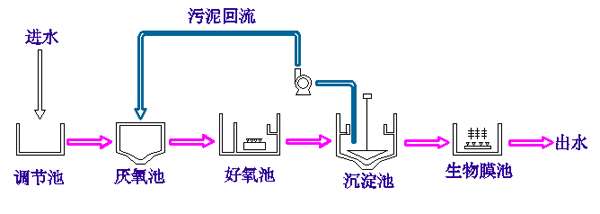
The Membrane Bioreactor (MBR) process combines biological wastewater treatment with membrane separation technology. Wastewater entering the reactor undergoes biological treatment where organic pollutants are broken down and converted. After biological treatment, the wastewater passes through microfiltration (MF) or ultrafiltration (UF) membranes. These membranes separate solids from liquid, achieving final purification of the wastewater.

The membrane modules installed in the reactor replace several conventional treatment units. These include secondary clarifiers, sand filters, and adsorption units. The MBR design allows independent control of hydraulic retention time (HRT) and sludge retention time (SRT). The result is stable, high-quality effluent.

Key Advantages

Membrane Separation

The membrane separation process achieves complete removal of suspended solids, colloidal materials, and microorganisms from the treated water. Conventional treatment processes rely on gravity settling, which can be incomplete. Filtration and adsorption steps require additional equipment and maintenance. MBR eliminates these separate steps. The effluent quality is consistently superior to conventional treatment.

Independent HRT and SRT Control

The integrated MBR retains biomass within the reactor regardless of hydraulic flow rate. Conventional systems lose biomass when hydraulic retention time is short. In MBR, long sludge ages are maintained even at short hydraulic retention times. This separation improves biological treatment efficiency. System operation becomes flexible and stable across varying flow conditions.

Simple Process Flow and Compact Footprint

The integrated MBR process flow is simple and easy to integrate into existing facilities. The treatment system occupies approximately half the footprint of conventional treatment. This space saving is valuable at sites with limited land availability. The system operates using a programmable logic controller (PLC). Automatic control reduces operator labor requirements. PLC control also monitors membrane performance and initiates backwashing cycles. Operating costs are reduced through efficient chemical cleaning and energy management.

Customized Implementation

Haihui provides specific implementation plans based on each customer’s actual site conditions, flow rates, influent characteristics, and effluent discharge or reuse requirements.
Related Products

Belt Filter Press for Industrial Sludge Dewatering and Solid-Liquid Separation

Belt Filter Press for Industrial Sludge Dewatering and Solid-Liquid Separation Product Details Belt Filter Press for Industrial Sludge Dewatering and Solid-Liquid Separation The belt filter press offers several key advantages: high pressure, strong dewatering capability, a high degree of automation, and simple operation. The discharged material achieves a moisture content of less than 78%. This…

Printing and Dyeing Wastewater Technology for Color and COD Removal

Printing and Dyeing Wastewater Technology for Color and COD Removal Product Details Printing and Dyeing Wastewater Technology for Color and COD Removal Key Technologies The anaerobic hydrolysis and acidification stage modifies the molecular structure of complex organic compounds. Large, non-biodegradable dye molecules are broken down into smaller, more readily biodegradable intermediates. This transformation creates favorable…

Flue Gas Desulfurization Wastewater Treatment System for Coal-Fired Power Plants

Flue Gas Desulfurization Wastewater Treatment System for Coal-Fired Power Plants Product Details Flue Gas Desulfurization Wastewater Treatment System for Coal-Fired Power Plants The flue gas desulfurization (FGD) wastewater treatment system is designed using optimized principles and methods. It offers high treatment efficiency, low operating costs, and low energy consumption. This system is widely used for…

Tannery Wastewater Treatment Technology for Chrome, Sulfide and Organic Control

Tannery Wastewater Treatment Technology for Chrome, Sulfide and Organic Control Product Details Tannery Wastewater Treatment Technology for Chrome, Sulfide and Organic Control Sulfide Wastewater Treatment Sulfide-laden wastewater from tannery beamhouse operations is treated using catalytic oxidation. Manganese sulfate (MnSO₄) is added as a catalyst to accelerate the oxidation of sulfides. After catalytic oxidation, a sulfur…

HZIC Anaerobic Internal Circulation Reactor for Industrial High-Strength Wastewater Treatment

HZIC Anaerobic Internal Circulation Reactor for Industrial High-Strength Wastewater Treatment Product Details HZIC Anaerobic Internal Circulation Reactor for High-Strength Wastewater Treatment Introduction to the HZIC Anaerobic Reactor The HZIC anaerobic reactor is a third-generation anaerobic treatment system developed from research on the Upflow Anaerobic Sludge Blanket (UASB) reactor. It uses a two-stage three-phase separator to…

Municipal Wastewater Treatment System for Domestic Sewage and Industrial Discharge

Municipal Wastewater Treatment System for Domestic Sewage and Industrial Discharge Product Details Haihui Water Treatment Division: Comprehensive Services for Industrial and Municipal Wastewater The Haihui Water Treatment Division offers a full range of services including consulting and design, proprietary equipment manufacturing, engineering installation, process commissioning and startup, operator training, and facility operation and maintenance under…