بكرات حزام النقل: الفولاذ مقابل الأقراص المطاطية مقابل البكرات الحلزونية — أيها الأفضل؟
- Key Notes Symphony: Conveyor Belt Idler
- Roll surface design determines idler life
- Bearing and seal design in one-piece construction
- Smooth roll end design on seamless tubes
- Labyrinth seal design cuts contamination ingress
- Continuous rotation with regreasable or factory-sealed bearings
- Heavy-duty shaft and roll construction reduces failure force
- Enhanced material compatibility for diverse loads
- Simplified installation and maintenance on high-speed conveyors
- Meets CEMA and MT standards for load and safety
- Conveyor Belt Idler
- Generic Rollers
A حزام ناقل idler isn’t just a spinning tube under the belt, it’s the difference between a conveyor that runs smoothly for years and a line that keeps throwing tantrums. When idlers seize, belts track crooked, material spills, and maintenance crews spend their shifts chasing problems instead of preventing them.
Old steel idlers had their moment, but modern bulk handling demands, abrasive materials, and wet sticky loads don’t have time for the wrong roll surface. This comparison cuts straight to what keeps operations fast, safe, and profitable across mining, cement, port, and steel plants.
Key Notes Symphony: Conveyor Belt Idler
➔ Roll Surface Selection: Steel for dry abrasives, rubber disc for sticky wet loads, spiral for self-cleaning in corrosive environments.
➔ Bearing & Seal Logic: Labyrinth seals with regreasable or factory-sealed bearings determine idler life in dust, moisture, and high-pH conditions.
➔ Load Rating Discipline: CEMA Class B through F idlers match load capacity to belt width and material weight — undersizing guarantees premature failure.
➔ Frame Compatibility: Interchangeable mounting dimensions per CEMA 502 ensure drop-in replacement without structural modification.
Hard-To-Maintain Conveyors? Try the Right Idler for the Job
Many operations want idlers that spin freely without constant attention. The right conveyor belt idler answers that need by balancing load capacity, seal integrity, and roll surface compatibility with the material being handled.
Roll surface design determines idler life
A conveyor belt idler benefits from a roll surface matched to the material. Instead of relying on bare steel for every application, modern designs select the surface based on whether the load is dry, sticky, abrasive, or corrosive.
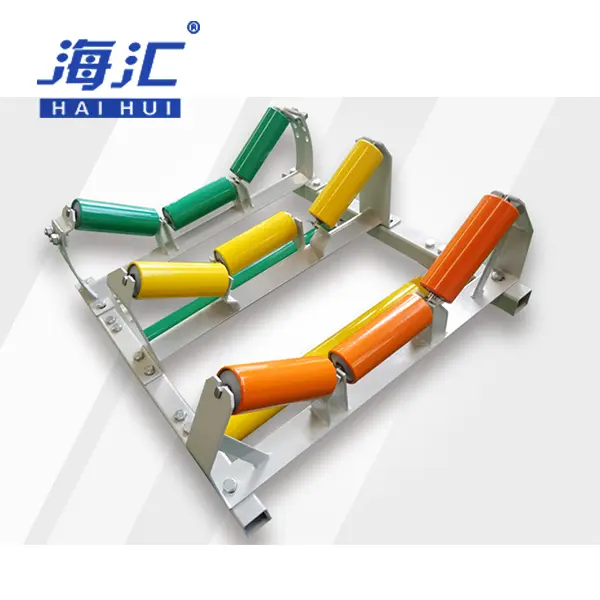
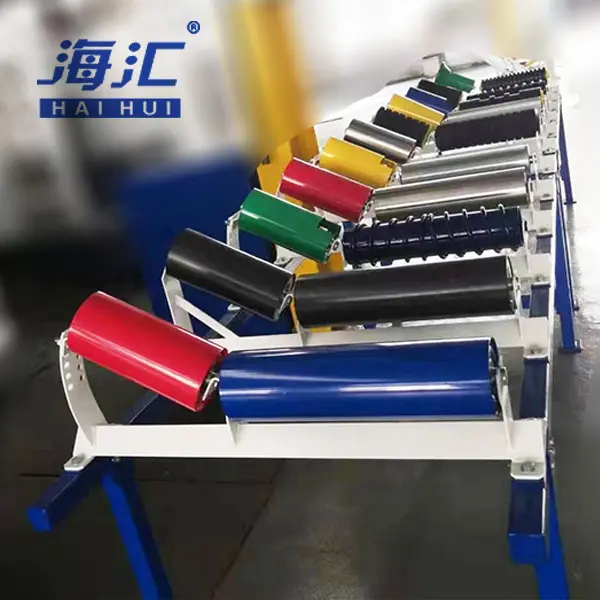
Roll surface options:
- Steel roll: Standard for dry, non-sticky, abrasive materials. Simple, durable, cost-effective.
- Rubber disc roll: Used where sticky materials adhere to the belt. Discs reduce buildup that causes belt training problems and damage to belting and framework.
- Spiral roll: Unique construction minimizes belt fleet and damage to the return belt due to material build-up on the idler rolls. Spiral roll idlers can be used for belt travel in one direction only.
- Urethane / ceramic covered: For high-abrasion or high/low pH materials.
Practical value:
- Steel idlers: Best for coal, aggregate, and dry ore.
- Rubber disc idlers: Best for wet, sticky, or muddy materials.
- Spiral idlers: Best for self-cleaning return runs in corrosive environments.
The result is a conveyor belt idler that matches the material instead of fighting it.
Bearing and seal design in one-piece construction
A modern conveyor belt idler improves reliability through a bearing and seal system integrated into a compact roll assembly. This mechanism removes unnecessary complexity and simplifies the maintenance path.
Key effects include:
- Lower contamination risk during operation.
- Better consistency across long overland conveyors.
- Improved compatibility with washdown and high-moisture conditions.
Performance comparison:
| ميزة | Basic Steel Idler | Sealed Labyrinth Idler | Relative Benefit |
|---|---|---|---|
| Seal type | Single contact | Multi-passage labyrinth | Reduced contamination |
| Bearing life tendency | Moderate | Extended | Improved reliability |
| Regreasable option | No | Yes (B+, C, D series) | Broader application range |
For maintenance crews, a sealed labyrinth idler with the right bearing reduces variability. For operations, the benefit is simple: fewer seized rolls and steadier belt performance over time.
Smooth roll end design on seamless tubes
A well-designed conveyor belt idler often removes the need for a sharp roll end transition. Using formed roll ends, the idler achieves a cleaner belt contact and more comfortable material flow.
Material structure:
- Seamless tube construction: Fewer transition points across the roll surface.
- Protective finishes: Painting, rubber, powder coating, or galvanizing for corrosion resistance.
User advantages:
- Handling: The smooth roll surface reduces belt pinch points.
- Waste reduction: Reduced material buildup on the roll.
Commercial impact:
- Packaging efficiency: Interchangeable dimensions simplify logistics.
- Brand presentation: Haihui highlights modern idler design that supports both usability and service life.
By combining seamless construction with smart sealing, the conveyor belt idler offers a practical path toward longer belt life and lower maintenance.
Data Shows Significant Life Extension With the Right Idler
A conveyor belt idler is often judged by how long it spins freely. Operators want low drag, steady tracking, and dependable rotation. Haihui focuses on details that influence idler life, from seal design to roll surface and material selection.
Labyrinth seal design cuts contamination ingress
The performance of a conveyor belt idler starts inside the bearing cavity.
Core influence:
- A multi-passage labyrinth seal creates a tortuous path for contaminants.
- Lower grease contamination supports effective drag reduction.
- The bearing encounters less resistance during rotation.
Material benefits:
- The protective seal also limits corrosion.
- Bearing consistency is maintained over storage periods.
- Compatibility improves with high-pH and high-moisture materials.
For operators, the sealed idler feels less stubborn and more responsive.
Continuous rotation with regreasable or factory-sealed bearings
A properly specified bearing helps shorten the path between installation and long service life.
Key advantages include:
- Consistent rotation across changing load conditions.
- Reliable bearing performance in dust and moisture.
- A smoother delivery system that supports conveyor availability.
In day-to-day use, a conveyor belt idler gains life because fewer contamination interruptions occur. Haihui applies this approach to help idler selection feel predictable.
Heavy-duty shaft and roll construction reduces failure force
The conveyor belt idler also benefits from thoughtful construction.
Structural factors:
- The shaft uses 20#/40# steel or stainless steel depending on the application.
- Reduced deflection supports lower bearing load.
- Better handling can improve maintenance safety.
Performance factors:
- Optimized material properties strengthen the roll body structure.
- Durability remains intact during transport and installation.
- Recyclability goals are supported through steel and rubber component recovery.
Haihui combines these features so a conveyor belt idler delivers life without sacrificing strength or compliance.
3 Advantages Of Conveyor Belt Idlers
The conveyor belt idler is widely used across bulk material handling applications because it balances load support, belt protection, and maintenance efficiency. From abrasive ore to sticky cement, the right idler helps operations stay smooth. Haihui supports these goals with practical idler solutions designed for real-world demands.
Enhanced material compatibility for diverse loads
A conveyor belt idler performs well across a broad mix of materials, helping maintain belt integrity while supporting strong material compatibility.
Formulation performance:
- High-abrasion materials benefit from steel or ceramic roll surfaces, reducing unwanted wear between belt and idler.
- Sticky materials move through transfer points without creating additional buildup concerns.
- Different lump sizes and moisture profiles remain suitable within the same idler class range.
Material advantages:
- Advanced bearing and seal design supports stable storage conditions.
- Enhanced coatings contribute to corrosion prevention during transport and service life.
- The idler solution remains suitable for high-pH and high-moisture applications.
Practical outcomes:
- Better belt training consistency.
- Reduced risk of roll seizure.
- Greater flexibility for diverse material profiles.
A well-designed idler also allows operations to expand material portfolios without constantly changing conveyor specifications, making maintenance planning easier.
Simplified installation and maintenance on high-speed conveyors
When production volumes increase, small efficiency gains quickly add up. A conveyor belt idler supports a smoother installation process and reliable rotation across automated operations.
Maintenance workflow:
- Remove worn idler from frame.
- Mount replacement idler in brackets.
- Verify belt tracking.
- Resume operation.
Operational benefits:
- Higher maintenance efficiency.
- Better support for planned shutdowns.
- Reduced interruptions on the production line.
Typical performance indicators:
| Metric | Poorly Specified Idler | Correctly Specified Idler |
|---|---|---|
| Rotation resistance | High / erratic | Low / consistent |
| Belt tracking stability | Poor | جيد |
| Roller change-out time | Longer | Shorter |
| Expected L10 bearing life | Reduced | Extended |
The optimized bearing and seal mechanism promotes operational simplicity, while high-speed filling equipment, labeling systems, and palletizing stations can maintain a steadier production rhythm.
Meets CEMA and MT standards for load and safety
Regulatory expectations continue to evolve, and a conveyor belt idler is often selected to support compliance planning from the start.
Environmental alignment:
- Supports adherence to applicable load rating standards.
- Helps address key dimensional standards in multiple markets.
- Encourages use of recyclable materials where suitable.
Regulatory management:
- Assists with CEMA 502 load rating objectives.
- Supports broader regulatory adherence programs including MT/T 821 for coal mine applications.
- Helps operations navigate material restrictions and documentation requirements.
Safety and market access:
- Proper idler selection becomes easier when load class and roll diameter are clearly defined.
- Compliance efforts can align with transport and storage requirements.
- Attention to safety regulations may help reduce approval delays in international distribution.
For companies operating across regions, the CEMA Class B through F format and the MT/T 821 specification provide a practical route toward smoother compliance management.
Conveyor Belt Idler Vs. Generic Rollers
In bulk material handling, the choice between a properly specified conveyor belt idler and a generic roller affects daily operation, maintenance efficiency, and belt life. A modern conveyor belt idler is built for stable rotation and long service under load. This comparison highlights practical differences in load capacity, sealing, compatibility, and long-term value.
Conveyor Belt Idler
The conveyor belt idler has become a preferred solution because it blends load support with maintenance reliability. In many operations, a correctly specified idler supports a more controlled process, while maintenance teams appreciate the improved bearing and seal design.
User-focused advantages:
- Lower rotation resistance creates a smoother belt path.
- The modern idler reduces strain on the belt and frame.
- Its design aligns with current CEMA and MT standards.
Technical performance:
- A conveyor belt idler may integrate seal and bearing functions more effectively than generic alternatives.
- Improved load management
- Consistent rotation
- Enhanced sealing performance helps support belt integrity.
- Better containment
- Reduced seizure concerns
Production and compatibility benefits:
- The idler format supports maintenance consistency.
- Stable quality control
- Repeatable service outcomes
- The idler works well with many modern belt types.
- Many operations, including those supplied by Haihui, value the balance between innovation and operational efficiency.
Short version? It simply makes maintenance easier. The conveyor belt idler concept combines load capacity, sealing, and dependable performance in one practical package.
Generic Rollers
A generic roller reflects a basic design that has seen extensive use across different product categories. The familiar steel tube and bearing remain recognizable, yet bulk material handling often places greater demands on sealing and load control.
- Higher rotation resistance can make belt tracking less stable.
- The basic seal may be more susceptible to contamination during certain operating conditions.
- Integration with advanced sealing systems is generally more limited.
For practical use:
- Maintaining steady rotation often requires more frequent attention.
- Load capacity can become more challenging in demanding applications.
- Compatibility with newer idler classes may be less flexible.
The generic roller approach still has application in light-duty markets, and its manufacturing method is widely understood. Even so, when comparing performance factors side by side, the properly specified conveyor belt idler frequently offers stronger sealing, smoother rotation, and improved compatibility with modern belt conveyor systems.
From a bulk handling perspective, Haihui and other forward-looking manufacturers favor the correct idler class where safety, efficiency, and consistency are key priorities. The result is a solution that supports both production goals and everyday maintenance expectations.
FAQ about Conveyor Belt Idlers
Q: What is a conveyor belt idler?
A: A conveyor belt idler is a rotating component that supports the belt and the material being conveyed. Carrying idlers support the loaded belt on the carrying side. Return idlers support the empty belt on the return side.
Q: What is the difference between a carrying idler and a return idler?
A: Carrying idlers support the belt and material on the top side of the conveyor. Return idlers support the empty belt on the bottom side. CEMA Standard 502 defines dimensional and selection guidelines for both types.
Q: What are the main idler roll surface options?
A: Steel rolls are standard for dry, abrasive materials. Rubber disc rolls reduce buildup for sticky materials. Spiral rolls are self-cleaning for return runs in corrosive environments. Urethane and ceramic covers are available for high-abrasion applications.
Q: How do I choose the right CEMA idler class?
A: CEMA idler classes run from B (light-duty) through F (super heavy-duty). Selection depends on calculated idler load, belt width, material weight, and operating conditions. Undersizing the idler class leads to premature bearing failure.
Q: What is the minimum belt speed for proper discharge?
A: For 35-degree and 45-degree troughed belts, a minimum belt speed of 300 fpm is recommended for proper discharge.
Q: What spacing is normal for return idlers?
A: Normal spacing for return idlers is 10 feet. Impact idlers should be at least 6-inch diameter and spaced at 1-foot intervals to maximize belt protection and reduce skirtboard leakage.
Q: What is the difference between regreasable and factory-sealed idlers?
A: Regreasable idlers use a labyrinth and outer shield design, allowing periodic regreasing to flush contaminants. Factory-sealed idlers use the same seal design with a solid shaft and are a viable economic alternative where periodic regreasing will not be provided.
Q: What shaft materials does Haihui use for conveyor idlers?
A: Haihui idlers use 20#/40# steel or stainless steel shafts depending on the application. Tube material is typically Q235B carbon steel, with custom options available.
Q: What belt widths and roller diameters does Haihui offer?
A: Haihui conveyor idlers cover belt widths from 400 mm to 2400 mm and roller diameters from 54 mm to 219 mm. Custom sizes are available.
Q: Does Haihui manufacture idlers for all conveyor applications?
A: Haihui manufactures conveyor belt idlers for heavy-duty industrial conveyors in mining, cement, steel, power, port, chemical, and paper industries. We do not supply portable or light-duty conveyors used in warehouses or retail settings.
المراجع
- CEMA Standard 502-2004 – Bulk Material Belt Conveyor Troughing and Return Idlers: Selection and Dimensions. Conveyor Equipment Manufacturers Association.
- MT/T 821-2006 – Belt conveyor for coal mines — Idlers — Technical specification. National Mine Safety Administration.
- Regal Rexnord – Rex Belt Conveyor Idlers and Components: seal features, idler types, and load ratings. Rexnord technical library.
- Rexnord – Rex Idlers: Return idlers, spiral idlers, disc idlers, and belt training idlers. Rexnord technical documentation.
- Haihui Environmental Protection Equipment Co., Ltd. – Steel Carry Trough Idler Roller product specifications: belt width 400-2400 mm, roller diameter 54-219 mm, Q235B carbon steel, CEMA/AS/DIN/ISO/GB standards.
- Haihui Environmental Protection Equipment Co., Ltd. – High Precision Industrial Conveyor Roller with Sealed Bearing: ISO 9001 certified, belt width 400-2400 mm, roller diameter 54-219 mm.
- Haihui Group – Company profile: ISO9001, ISO14001, ISO45001, ISO50001 certified, annual output of 16,000+ sets of conveying machinery and environmental equipment.
- Regal Rexnord – Rex Belt Conveyor Idlers: CEMA Class B through F load ratings and roll diameters.
- Rizhao Daily – Haihui Environmental overseas orders grow, production capacity utilization exceeds 95%.

 English
 العربية
 Русский
 Español
 Português do Brasil