
Cansado de roletes emperrados? Experimente roletes com especificações adequadas
- Essential Insights: Idler Rollers
- Enhanced Belt Support with Steel Tube Walls
- Idler Roller Body Meets ISO 9001 & CEMA 502 Compliance
- Labyrinth Seal Interior for Bearing Preservation
- Roll Diameter Design Minimizes Belt Fatigue
- Shaft Diameter for Even Load Distribution
- Properly Sealed Idlers
- Basic Rollers
- Selecting the Right Steel or Stainless Material
- Optimizing Roll Diameter & Bearing Fit
- Leak Testing and Material Certification
- Press-Fit Seal & Weld Seam Integrity
- Wall Thickness, Diameter & Load Resistance
- Deep Drawing Process for Uniform Tube Strength
- SGS Certification & ISO 9001 Standard Rotation Testing
A seized idler roller is a costly little villain. It doesn’t announce itself with a warning light—it announces itself with belt damage, spillage, and downtime that eats into your production schedule. An idler roller can guard your belt from misalignment, abrasion, and fatigue while adding structural support through the entire conveyor line—but specification matters. Roll diameter, tube wall thickness, bearing seals, and load class separate a reliable idler from a flashy claim.
For wholesale and OEM buyers, dimensions, material documentation, bearing quality, and production consistency deserve equal scrutiny before ordering.
Essential Insights: Idler Rollers
➔ Enhanced Support: Steel tubes and sealed bearings shield the belt from sag, misalignment, and edge damage.
➔ Compliance Assurance: Idler rollers meet ISO 9001, CEMA 502, and MT/T 821 standards for consistent load ratings and dimensional interchangeability.
➔ Precision Sealing: Multi-passage labyrinth seals, controlled grease fill, and leak testing deliver extended bearing life in dust and moisture.
➔ Resistência estrutural: Optimal wall thickness, shaft diameter, and weld integrity resist belt tension and impact loads without deformation.
➔ User Convenience: Interchangeable CEMA dimensions support drop-in replacement, and reliable coatings preserve roller life between maintenance cycles.
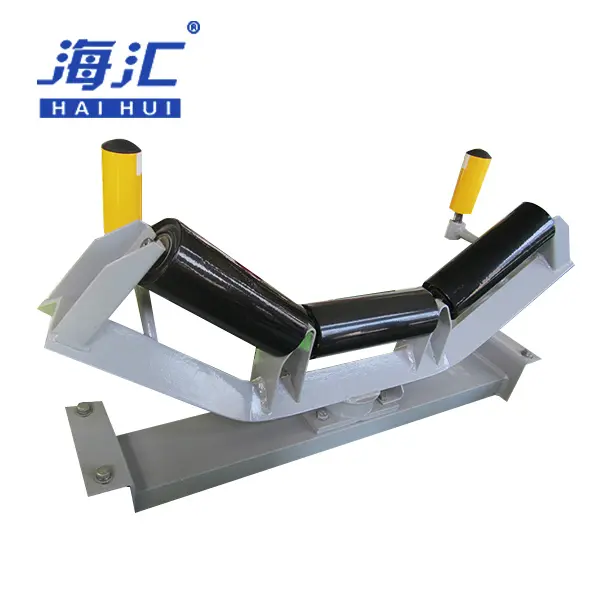
5 Reasons Your Conveyor Needs Properly Specified Idler Rollers
An idler roller gives the belt a practical support system against everyday operating threats. From the steel tube to the sealed bearing, small specification details can make a real difference. For operations teams, that means longer belt life and less fuss.
Enhanced Belt Support with Steel Tube Walls
- Conveyor support starts with a strong outer shell.
- Steel tubes and rigid roll walls block dust and resist everyday impact.
- The durable roller also limits belt sag and outside contamination when paired with a tight seal.
- That supports better belt training from loading point to discharge.
Idler Roller Body Meets ISO 9001 & CEMA 502 Compliance
A well-made steel tube body brings strength and wear resistance to an idler roller. For Haihui idlers, documented ISO 9001 quality controls support consistent manufacturing, while CEMA 502 defines dimensional and load rating requirements.
- Safety certification documentation helps buyers check claims.
- A defined quality standard supports repeatable production and material safety controls.
Labyrinth Seal Interior for Bearing Preservation
- A multi-passage labyrinth seal creates a protective barrier between the bearing and the environment.
- Its non-contact design helps reduce drag while blocking contaminants.
- Better bearing protection supports extended roller life.
- Combined with an effective grease fill, delicate bearing surfaces have a better shot at staying clean.
Roll Diameter Design Minimizes Belt Fatigue
- The roll diameter shapes the belt path around the idler.
- A properly sized roller reduces unnecessary bending stress on the belt carcass.
- Less bending stress supports longer splice life.
- A true minimum diameter, however, depends on belt type and tension.
A correctly sized idler roller still works best when matched to the belt’s actual load and speed.
Shaft Diameter for Even Load Distribution
The shaft diameter combines practical load capacity with deflection control. Belt tension and material weight transfer through the shaft to the frame.
- Predictable load distribution keeps bearing stress within design limits.
- That makes continuous operation more stable and supports clean belt tracking.
How Properly Sealed Idlers Beat Basic Rollers Easily
Conveyor support gets tricky once dust, moisture, and daily impact enter the mix. A properly sealed idler roller gives the belt a rigid support point, while a basic roller trades protection for lower cost. For everyday operations, the practical difference comes down to seal quality, bearing life, and how often the roller needs attention.
Properly Sealed Idlers
A properly sealed idler roller pairs a durable tube with an effective seal, helping limit contaminant ingress after installation. That’s pretty handy.
- Protection
- Seal control: Labyrinth seals support contaminant exclusion, slowing bearing wear and improving service life.
- Meio ambiente
- The steel tube supplies a strong wear barrier and resists impact, two useful traits for bulk material handling.
- Rigid walls also prevent tube deformation during normal operating loads.
- Daily use
- A Haihui idler roller combines practical belt support with bearing protection, without requiring constant greasing.
| Reference condition | Numeric value | Unit | Storage relevance |
|---|---|---|---|
| Standard atmosphere | 101.325 | kPa | Pressure reference |
| Ambient temperature range | -20 to +40 | °C | Operating condition |
| Rotation resistance limit | ≤ 3.5 | N | Bearing drag reference |
| Radial runout limit | ≤ 0.5 | mm | Roll concentricity |
Basic Rollers
A basic roller uses a simple tube and contact seal, so it is light, cheap, and easy to install. Convenience is the big win.
- The simple design provides compact dimensions for standard frames.
- Its basic seal is quick to install.
- Frequent exposure to dust can leave more contamination inside unless the seal is upgraded before installation.
- Compared with a properly sealed idler, the basic seal offers less protection against dust and moisture. For longer service life, that trade-off can matter.
Loading Zone Scenario: Proper Idlers Keep Belts Tracking
A good idler roller does more than spin under the belt. For bulk handling operations, the right tube, sealed bearing, and verified load rating help slow dust and moisture exposure, so the idler can protect belt tracking between maintenance cycles.
Selecting the Right Steel or Stainless Material
Choosing the tube starts with how the conveyor will be operated.
- Carbon steel
- Durability: Its steel base gives an idler roller useful stiffness against everyday impact.
- Wall thickness: A suitable gauge helps prevent dents while keeping the roller practical.
- Protective coating: Painted or galvanized surfaces should suit the operating environment and support corrosion resistance.
- Stainless steel
- A corrosion-resistant alloy makes washdown and chemical exposure manageable.
- Stainless naturally resists rust, though coating choice still matters for stored equipment.
Load class should match belt width, too. Less oversized roller means less wasted cost after installation.
Optimizing Roll Diameter & Bearing Fit
A roll diameter and bearing fit work well when their dimensions closely match. Small tolerance changes can make the difference between smooth rotation and, well, annoying vibration.
- Check the tube concentricity for even belt contact around the circumference.
- Add a labyrinth seal when the environment requires extra protection.
- Verify rotation resistance after repeated operation.
For a properly specified idler roller, dependable bearing fit reduces vibration and supports belt stability between maintenance cycles.
Leak Testing and Material Certification
Closure claims need evidence rather than guesswork.
- Confirm rotation resistance testing under defined test conditions.
- Record the radial runout method and acceptance limit.
- Check seal integrity across multiple finished rollers.
- Review material documentation.
- A material declaration should identify relevant steel grades, bearings, or polymer parts.
- Supporting certification should match applicable quality rules and documentation needs.
That paperwork helps buyers distinguish a tested idler roller from one that merely feels tight.
How Extended Sealing Extends Roller Life
A properly sealed idler roller reaching extended L10 bearing life limits fresh contaminant ingress, giving bulk material handling a practical defense against dust, moisture, and bearing seizure while keeping daily operations simple.
Press-Fit Seal & Weld Seam Integrity
A reliable idler roller depends on two closely matched barriers:
- Seal contact
- A precise labyrinth seal creates a contaminant barrier through multiple passage changes.
- A stable seal assembly supports repeatable rotation resistance after installation.
- Body connection
- An even weld seam closes small air and dust paths.
- Better structural integrity helps protect bearing life. Tiny gaps matter, so good fit is a big deal.
Wall Thickness, Diameter & Load Resistance
For an idler roller, dimensions directly affect strength. Wall thickness supplies tube rigidity, while roll diameter changes how forces spread across the roller.
- Balanced dimensions improve roller stability without wasting steel.
- Suitable load resistance limits tube deflection under changing belt tension.
- Reliable dimensional control helps the roller hold its intended shape and seal.
Deep Drawing Process for Uniform Tube Strength
An idler roller can gain consistency from controlled tube forming:
- Forming quality
- The manufacturing process shapes steel tube through controlled force.
- Careful metal forming promotes uniform wall thickness.
- Sealing quality
- A seamless body removes potential joint weaknesses.
- Higher production precision keeps bearing alignment steady, supporting repeatable service life. That makes quality easier to keep on track.
SGS Certification & ISO 9001 Standard Rotation Testing
Certification alone does not prove every idler roller is defect-free.
- Verification
- SGS certification can provide independent evidence against defined requirements.
- A documented ISO 9001 standard supports controlled production.
- Finished-roller checks
- Rotation resistance testing finds unwanted drag.
- Routine seal inspection strengthens quality assurance.
- Recorded industrial testing supports traceability and load compliance for each production run.
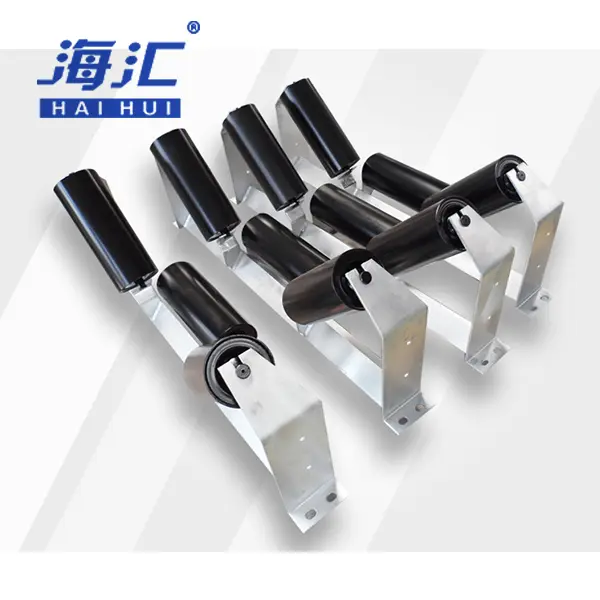
Idler Roller Specifications at Haihui
A Haihui Environmental Protection Equipment Co., Ltd. é uma fabricante de transportador de correia rolas, polias e componentes estruturais, com sede em Rizhao, Shandong, China. A empresa opera 12 oficinas de produção inteligentes com capacidade de produção anual de 15.000 conjuntos de equipamentos e detém 168 patentes registradas, incluindo 15 patentes de invenção.
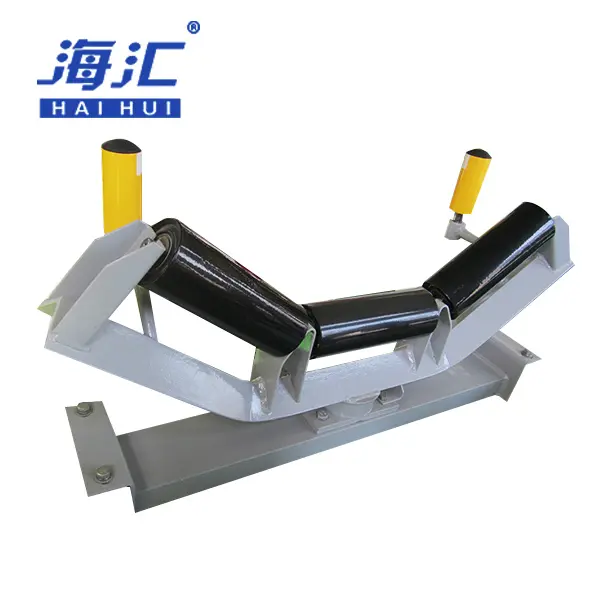
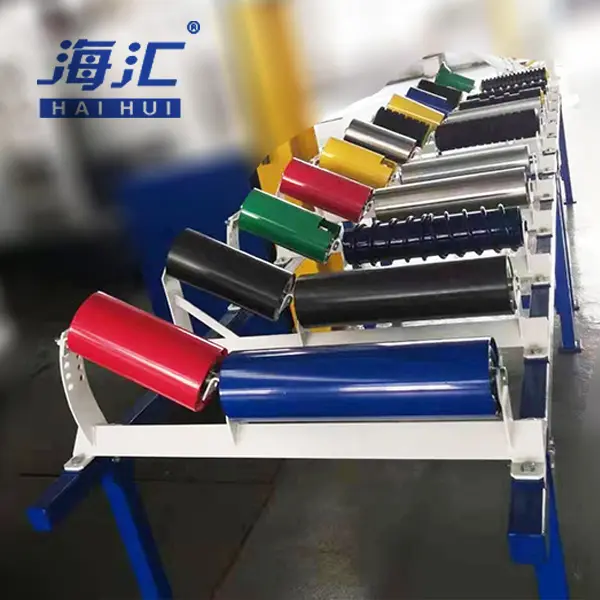
Escopo do produto: carrying idler rollers, return idler rollers, impact idler rollers, spiral idler rollers, rubber disc idler rollers, and complete idler assemblies for belt conveyors. Belt widths from 400 mm to 2,400 mm; roller diameters from 54 mm to 219 mm. Materials include Q235B carbon steel, Q345B high-strength steel, and stainless steel for corrosive applications.
Sistemas de qualidade: Certificada pelas normas ISO 9001, ISO 14001, ISO 45001 e ISO 50001. Os produtos são fabricados de acordo com as normas CEMA, AS, DIN, ISO e GB.
Mercados de exportação: Os produtos são exportados para os Estados Unidos, a Rússia, o Canadá, a Austrália, o Egito, a América do Sul, o Oriente Médio e o Sudeste Asiático.
Capacidade de atendimento: Equipe profissional de vendas com atendimento 24 horas por dia, entrega de amostras em 1 a 2 dias, personalização OEM para produtos, logotipos e embalagens, além de aceitação de pedidos em pequenas quantidades para necessidades urgentes.
FAQ about Idler Rollers
Q: What is an idler roller?
A: An idler roller is a rotating component that supports the belt and the material being conveyed. Carrying idler rollers support the loaded belt on the carrying side. Return idler rollers support the empty belt on the return side.
Q: What are the main types of idler rollers?
A: The main types are carrying idler rollers, return idler rollers, impact idler rollers, training idler rollers, and spiral idler rollers. Each type serves a specific position and function on the belt line.
Q: What is the difference between a carrying idler roller and a return idler roller?
A: Carrying idler rollers support the belt and material on the top side of the conveyor. Return idler rollers support the empty belt on the bottom side. CEMA Standard 502 defines dimensional and selection guidelines for both types.
P: Como faço para escolher a classe correta de roletes CEMA?
R: As classes de roletes da CEMA vão de B (serviço leve) até F (serviço superpesado). A escolha depende da carga calculada do rolete, da largura da correia, do peso do material e das condições de operação. Escolher uma classe de rolete inferior à necessária leva à falha prematura do rolamento.
Q: What is the normal spacing for return idler rollers?
A: Normal spacing for return idler rollers is 10 feet (approximately 3 meters). Impact idlers should be at least 6-inch diameter and spaced at 1-foot intervals to maximize belt protection.
Q: What is the difference between regreasable and factory-sealed idler rollers?
R: As roldanas com lubrificação reabastecível utilizam um projeto com labirinto e proteção externa, permitindo a relubrificação periódica para eliminar contaminantes. As roldanas vedadas de fábrica utilizam o mesmo projeto de vedação com eixo sólido e constituem uma alternativa econômica viável nos casos em que não é possível realizar a relubrificação periódica.
Q: When should I use spiral idler rollers instead of plain steel rollers?
A: Spiral idler rollers are self-cleaning and suit sticky, wet, or corrosive materials. They are one-directional only and should not be used on reversing conveyors.
Q: What shaft materials are used for idler rollers?
R: Os materiais mais comuns para eixos incluem o aço 20#, o aço 40# e o aço inoxidável. A escolha do material depende da carga, da exposição à corrosão e dos requisitos de manutenção.
Q: What is the typical service life of an idler roller?
A: With proper specification and maintenance, an idler roller can last 20,000 to 50,000 hours. Sealed labyrinth bearings extend life in dusty or wet conditions.
Q: Does Haihui manufacture idler rollers for all conveyor applications?
A: Haihui manufactures idler rollers for heavy-duty industrial conveyors in mining, cement, steel, power, port, chemical, and paper industries. We do not supply portable or light-duty conveyors used in warehouses or retail settings.
Referências
- Norma CEMA 502-2004 – Calhas e roletes de retorno de transportadores de correia para materiais a granel: seleção e dimensões. Associação dos Fabricantes de Equipamentos de Transporte.
- MT/T 821-2006 – Transportador de correia para minas de carvão — Rolos — Especificação técnica. Administração Nacional de Segurança Mineira.
- Regal Rexnord – Rolos e componentes para correias transportadoras Rex: características das vedações, tipos de rolos e capacidades de carga.
- Haihui Environmental Protection Equipment Co., Ltd. – Especificações do produto “Rolo guia para calha de transporte de aço”: largura da correia 400–2.400 mm, diâmetro do rolo 54–219 mm, aço carbono Q235B.
- Haihui Environmental Protection Equipment Co., Ltd. – Rolo transportador industrial de alta precisão com rolamento vedado: certificado pela ISO 9001.
- Grupo Haihui – Perfil da empresa: certificado pelas normas ISO 9001, ISO 14001, ISO 45001 e ISO 50001.
- Jornal Rizhao – A Haihui Environmental registra aumento nas encomendas do exterior; a taxa de utilização da capacidade produtiva ultrapassa 95%.
 English
 العربية
 Русский
 Español
 Português do Brasil